
We’re glad you’re here!
mobi.mapr is currently undergoing a complete redesign to offer you a new and improved look and even more clarity in the future. We are working hard on the new version to make your experience easier, faster, and more intuitive.
The journey continues soon!
To make sure you don’t miss anything, sign up for our newsletter now and stay up to date!

How is the quality of mobility?
- On foot, by bicycle, public transport, or car
- For a range of goals and different activities
- For various personas
- To the right destination at the right time
- In cities, the suburbs, or in the rural areas
- From the state level down to areas the size of hexagons
Mobi.mapr is an analysis platform offering an independent and comprehensive assessment index to measure the quality of mobility. From the federal level to states and municipalities and even down to individual neighborhoods, mobi.mapr provides a quick overview and enables detailed analyses for individual modes of transportation, personas, and activities (e.g., accessibility of supermarkets, recreational facilities, or restaurants).
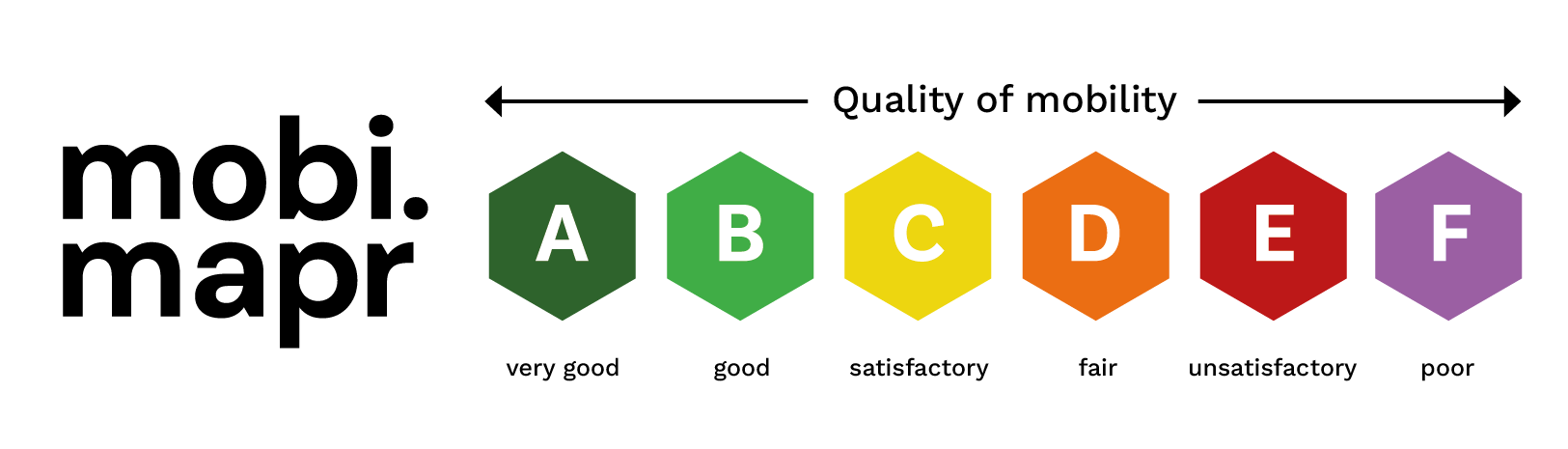
The mobility rating is dividing up similar to a framework for school grades spanning A (very good) to F (poor). It is based on a scoring system that combines objective accessibility data from high-resolution, Germany-wide routing (distance, time) with subjective qualitative parameters (e.g., ADFC bicycle climate test, lighting, road conditions).

Mobility
Mode
Activity
Persona
intermodal Routing
To make mobility quality measurable and comparable, mobi.mapr relies on a human-centered, constantly growing, and updated database for:
- 12 Personas (Source: MiD 2025)
- 130 Day-to-day activities
- 8 Modes of transportation
(Pedestrian (without restrictions, limited mobility, brisk), bicycle (everyday bike, cargo bike, e-bike), public transit, and automobile) - > 1.1 million hexagons
(Border length of 200 meters) - > 10.000 cities and municipalities
- 16 federal states
- ca. 4 billion routes
Analysis Example
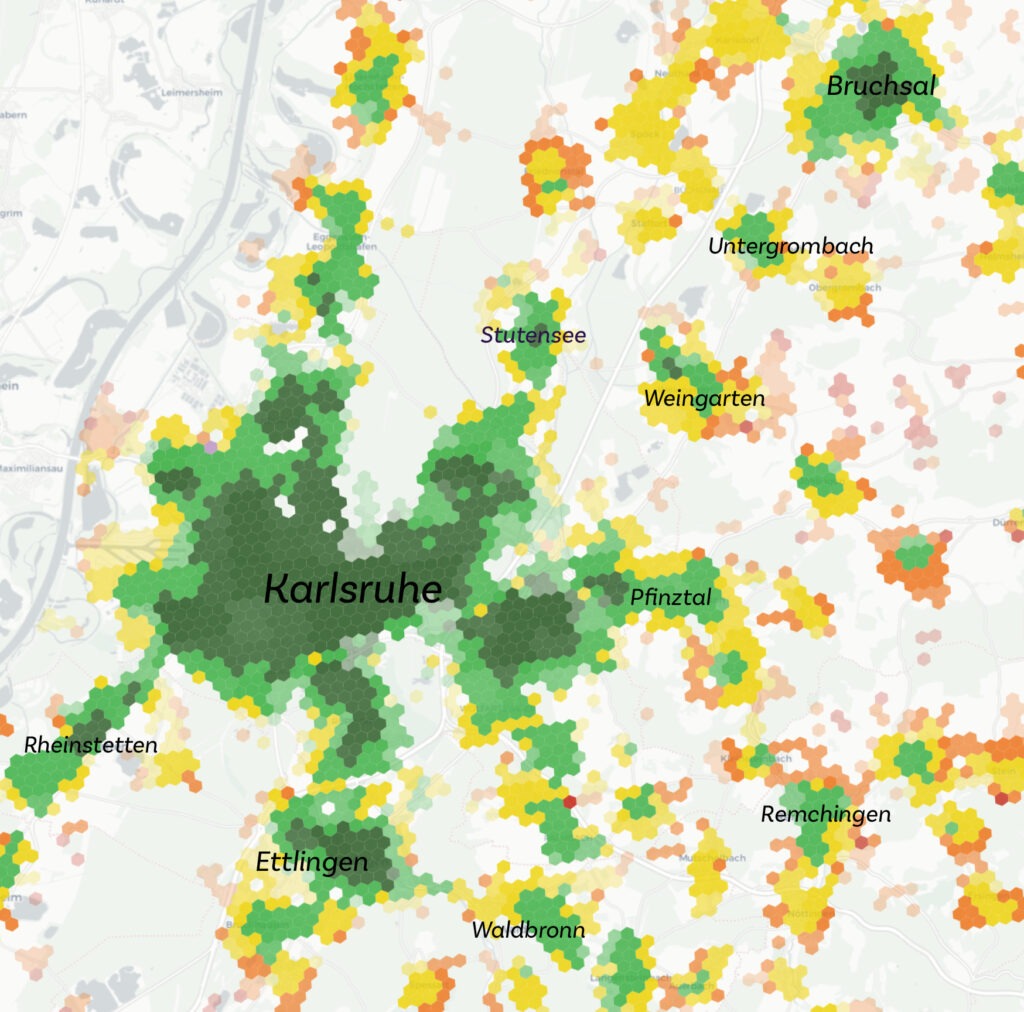
mobi.mapr – Regional Maps
Quality of mobility across all modes of transport
What is the quality of mobility when all modes of transport are available?
When it comes to quality of mobility, it is not only the number of transport options that counts, but also the range of activities available. For example, being able to shop in the village saves a trip to the nearest town—and thus time and traffic. It also makes it possible to run errands by bike or on foot. Closer activities therefore can increase the number of means of transportation.
mobi.mapr – detailed analysis:
With an automobile
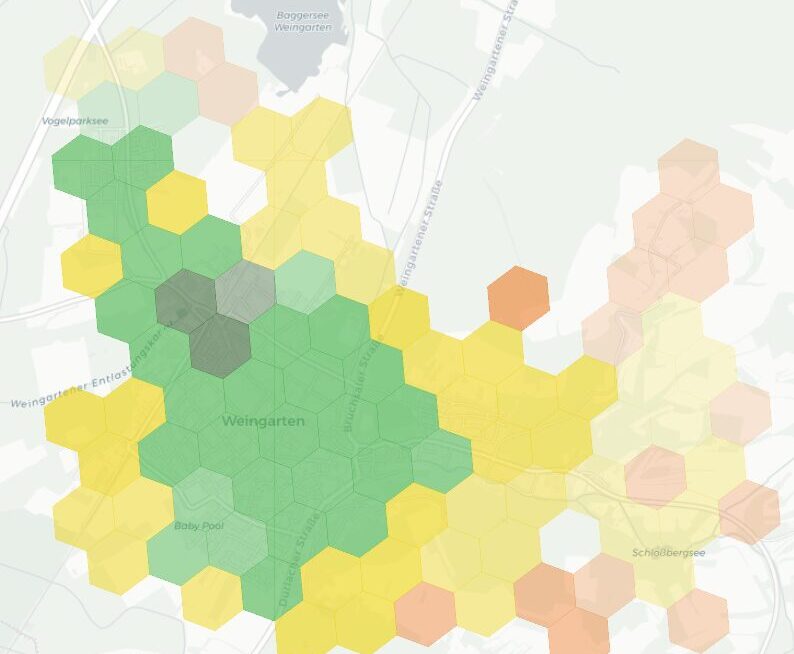
With eco-friendly transport*
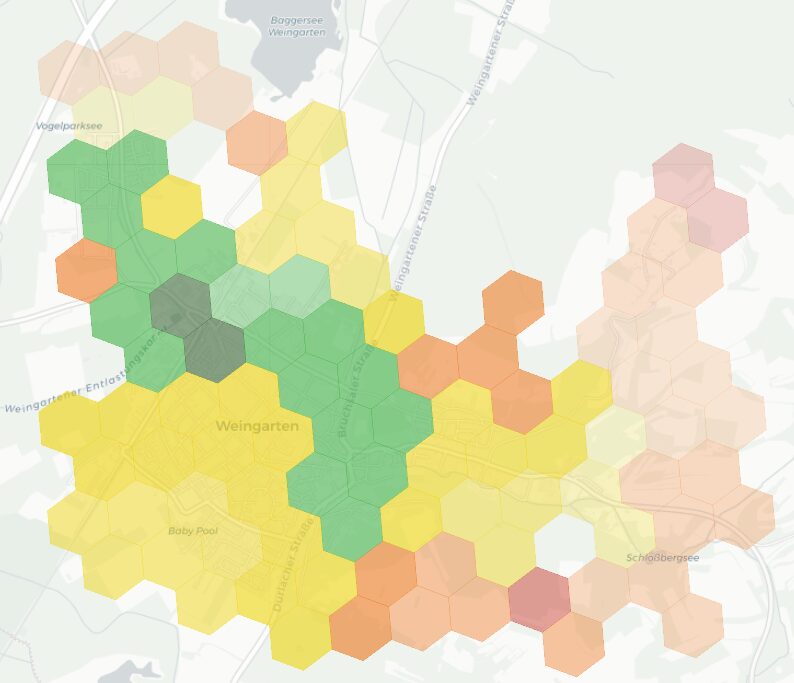
Example Activity:
Accessibility in eco-friendly transport
- C Supermarket
- A Doctor’s Office
- D Theatre
- A Swimming Pool
- A Playground
- A Restaurant
- C Bank / ATM
* Includes: Pedestrian, Bicycle, and public transit
Areas of application:
knowledge, planning, decision-making
mobi.mapr offers comprehensive analyses and ideas for designing sustainable, livable cities and regions at the touch of a button:
- Accessibility analysis of everyday destinations for people without cars
- Goal setting for mobility quality for political deciders
- Identification and analysis of mobility bottlenecks in urban and rural areas
- Strengthening civil society participation through transparent data visualization
- Comprehensive data and research resources for educational institutions and media outlets (free map downloads and publication in non-commercial or editorial contexts)
- Decision-making support for needs-oriented and need-based urban and transport planning for politicians, administrators, and civil society activists
- Promoting social inclusion and mobility equity for different groups of people
- Support for planning processes for the development of residential areas and infrastructure
- Site evaluation and development, e.g., planning of residential areas, public facilities, or company headquarters
- Benchmarking in a Germany-wide context to compare mobility quality, e.g., of cities or towns with similar populations or regions with similar structures
You have questions? Looking for more information?
You can find our FAQs here! (currently only available in German)
You can find detailed information on the methodology here (also currently in German). For further questions, please contact the project team at mobimapr@bw-im.de.
Team